
To scale your Facebook ads, wait until your ad set is out of the learning phase and your cost per result has held steady for about a week. Then grow it in small steps: raise your budget gradually, add new audiences or locations in separate ad sets, and keep fresh creative coming. Big sudden changes are what push your costs up.
That’s the short answer. The rest of this guide shows you how to tell when your campaign is ready, using real numbers from a WhatsApp leads campaign we ran in Rawalpindi and Islamabad in November 2026. After that, we walk you through the exact plan we’d follow to scale it.
Written by Iqra Sabir, Founder & CEO of Pulse Tech Agency. Last updated: 22 November 2026.
Contents
- When is a Facebook campaign ready to scale?
- Why results drop after you scale
- Vertical scaling: raise the budget the right way
- Horizontal scaling: new ad sets, cities and audiences
- Creative scaling: give Meta more to work with
- Our plan to scale a Rs8 WhatsApp campaign
- Scaling with a small PKR budget
- Mistakes that undo a good campaign
- FAQ
When is a Facebook campaign ready to scale?
Your campaign is ready to scale when three things are true at the same time:
- It has left the learning phase. Meta says an ad set generally needs about 50 optimization events in the week after its last significant edit to exit learning. Until you get there, your results will swing and your cost per result will run higher.
- Your cost per result is stable. Open a daily breakdown in Ads Manager. A few rupees of movement each day is normal, but if you see wild jumps, your campaign hasn’t settled yet.
- Each result is worth more than it costs you. A Rs8 WhatsApp chat only matters if enough of your chats turn into paying customers.
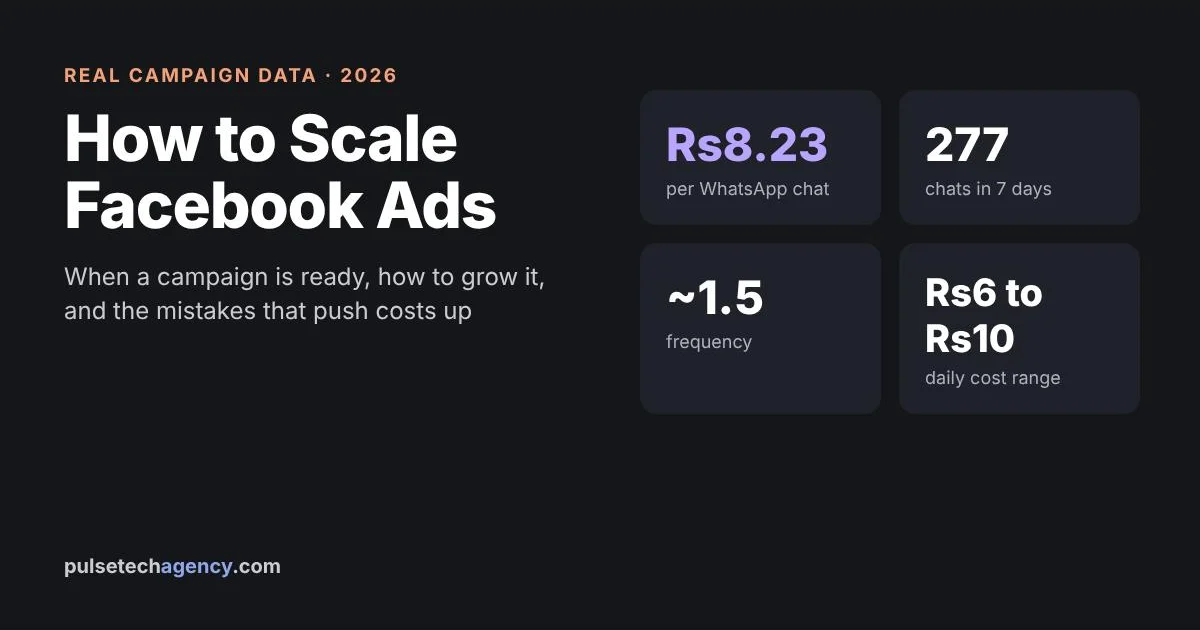
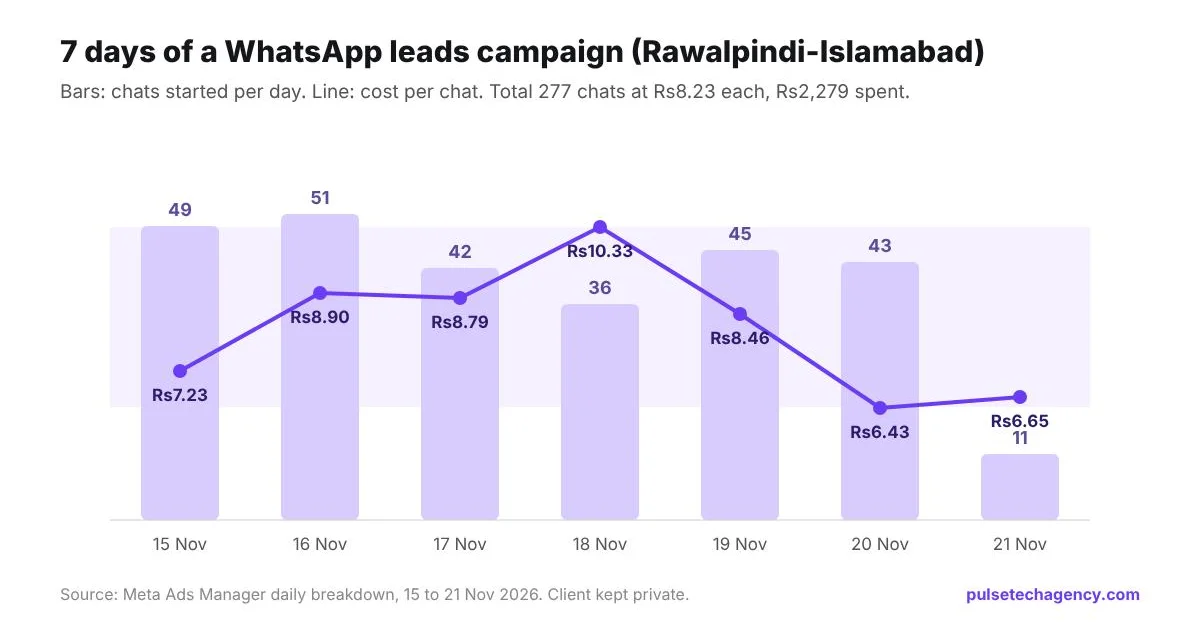
So what does a campaign that’s ready look like in a real account? This is a lead campaign we manage for a local service business in Rawalpindi and Islamabad (we keep client details private). We started it on 15 November 2026 and it stopped on the 21st, with one ad set, broad targeting for ages 22 to 60, and WhatsApp chats as the goal.
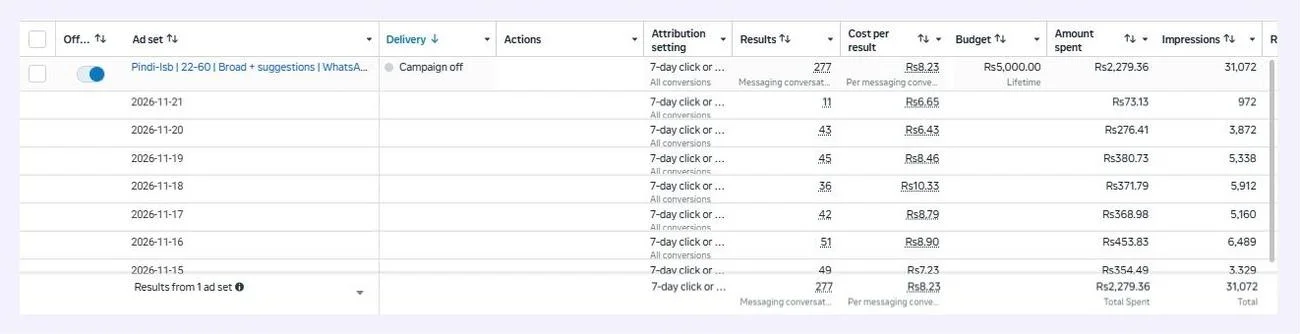
| Day | Chats started | Cost per chat | Spent |
|---|---|---|---|
| 15 Nov | 49 | Rs7.23 | Rs354 |
| 16 Nov | 51 | Rs8.90 | Rs454 |
| 17 Nov | 42 | Rs8.79 | Rs369 |
| 18 Nov | 36 | Rs10.33 | Rs372 |
| 19 Nov | 45 | Rs8.46 | Rs381 |
| 20 Nov | 43 | Rs6.43 | Rs276 |
| 21 Nov | 11 | Rs6.65 | Rs73 |
| Total | 277 | Rs8.23 | Rs2,279 |
Here’s what we read from that table, and what you should look for in your own:
- Learning wasn’t a problem. The ad set brought in 49 chats on day one and passed 100 by the end of day two, so by Meta’s 50-a-week guideline it had enough data to leave learning very early.
- Cost held in a narrow band. Daily cost per chat stayed between Rs6.43 and Rs10.33, and the weekly average landed at Rs8.23.
- The audience was far from tired. The ad reached 21,268 people with 31,072 impressions, which works out to a frequency of about 1.5, meaning most people saw it once or twice.
If your numbers look like this, you have a scaling candidate. What held this campaign back was budget, and the audience still had plenty of room.
Why results drop after you scale
So why do your costs often jump right after a budget increase? Most of the time, you’ve pushed the ad set back into learning.
Meta’s help page on the last significant edit lists what counts. If you pause an ad set or change its optimization event, audience or creative, that’s a significant edit. Changes to your budget or bid strategy may count too, depending on how big they are, and Meta doesn’t publish an exact budget threshold.
Each time learning restarts, Meta goes back to exploring. During the learning phase, your delivery is less stable and your cost per action is usually worse. If your ad set can’t collect enough results to exit, Ads Manager shows Learning limited.
Meta also puts a number on what staying in learning costs you. On its performance marketing page, Meta says advertisers who keep under 20% of their overall spend in learning can lower cost per purchase by as much as 68%. That’s Meta’s own figure, so you should treat it as a direction more than a promise.
The other two reasons are simpler. A bigger budget reaches people who are less likely to respond than the first group Meta found for you, and more spend on the same ad means the same people see it again and again, so your frequency climbs and response falls.
Vertical scaling: raise the budget the right way
Vertical scaling means you add budget to the ad set or campaign that’s already working. It’s the fastest route you have, and the riskiest one.
Here’s how you can do it without resetting everything:
- Raise in steps. Most media buyers add about 10 to 20% at a time and wait two or three days before the next step. Meta has never confirmed a safe percentage, so treat 20% as a working rule.
- Watch your Delivery column after each change. If you see “Learning” there again, leave the ad set alone for a few days.
- Change one thing at a time. If you raise your budget and swap your creative on the same day, you won’t know which change moved your costs.
- Pick the right budget type. Our example used a Rs5,000 lifetime budget, which Meta paces over the whole schedule. A daily budget is easier to raise in small steps, so we switch to daily once a campaign proves itself.
- Use campaign budget when you run several ad sets. With Advantage+ campaign budget, Meta moves money toward whichever ad set is getting your cheapest results, so you only raise one number at campaign level.
Horizontal scaling: new ad sets, cities and audiences
Why not keep raising one budget forever? Because one ad set eventually runs out of cheap people to reach. Horizontal scaling means you reach new people with ads that already work, while your original ad set keeps running untouched beside them.
Ways you can do it:
- New locations. If your campaign works in Rawalpindi and Islamabad, Lahore or Faisalabad is a good first test. Put the new city in its own ad set so you can compare your cost per result.
- Lookalike audiences. Build a lookalike from people who already contacted you, such as your WhatsApp chatters or form leads, and test it in a separate ad set.
- Broader targeting. If your first ad set used interests, test one with broad targeting and Advantage+ audience. Our example already ran broad, which is part of why it found people cheaply.
- New placements. If you limited placements at launch, test a version with all placements on.
Give each new ad set enough budget to reach around 50 results in its first week. If you split the same money across five small ad sets that each get 10 results, all five will sit in learning, while one ad set with the full budget can leave it.
Creative scaling: give Meta more to work with
Your creative is often the real ceiling, because when the same ad runs at a higher budget, it wears out faster.
- Add new ads in a new ad set once your main ad set is stable, since adding ads to a running ad set can restart its learning.
- Make variations of your winner. Keep the offer, and change the first line, the image or the first three seconds of the video.
- Watch your frequency. Once it climbs and your cost per result rises with it, a fresh creative usually helps you more than extra budget does.
Our plan to scale a Rs8 WhatsApp campaign
Treat this section as a plan, since we haven’t run these steps on this account yet. If the client asked us for more chats at a similar cost, this is what we would do, and you can copy the same steps for your own campaign.
We’d start by duplicating the ad set onto a daily budget of about Rs400, close to what the original spent per day, and leave it alone until its cost per chat settles near Rs8. Then we’d raise that daily budget by about 20% every two or three days, checking the Delivery column after each step. Once the main ad set holds steady, we’d open a second ad set for Lahore with the same ad, and a third with two new creative variations, so we can see whether a new city or a new ad brings cheaper chats.
| Step | What we’d change | What we’d watch |
|---|---|---|
| 1 | Duplicate the ad set with a daily budget of about Rs400 | Cost per chat stays near Rs8 |
| 2 | Every 2 to 3 days, raise the daily budget by about 20% | Delivery status and cost per chat after each step |
| 3 | Start a second ad set for Lahore with the same ad and Rs400 a day | Cost per chat compared with Pindi and Islamabad |
| 4 | Add 2 new creative variations in a third ad set | Frequency on the main ad set |
| 5 | Move to one campaign budget once 2 or 3 ad sets are stable | Which ad set Meta favors and why |
We’d also track what happens after the chat, because a chat that costs you Rs8 is cheap only if it leads to business. Count how many conversations turn into real enquiries and sales each week. Our Meta Ads guide covers how to measure that.
Scaling with a small PKR budget
Most Pakistani small businesses spend a few hundred to a few thousand rupees a day. You can still scale on that kind of budget, but the rules change slightly:
- Keep your ad sets few. With Rs500 a day, one or two ad sets is plenty, because if you split it across five, none of them collects enough results to leave learning.
- Pick a goal that happens often. Our example reached 277 results in a week because a WhatsApp chat is a frequent action, while a goal like purchases may never reach 50 a week on a small budget.
- Scale in rupees you can afford to test. Going from Rs400 to Rs480 a day is a 20% step, and you’ll know within a few days whether it held.
For budget planning by industry, see what Facebook ads cost in Pakistan. Tracking matters too: if you optimize for leads on your website, set up the Meta Pixel and Conversions API first.
Mistakes that undo a good campaign
- Doubling your budget overnight. It can work, but it often sends your ad set back into learning and your costs jump.
- Editing during learning. Every change you make restarts the clock, so let the ad set settle before you judge it.
- Judging on one day. In our example, one day hit Rs10.33 per chat and another Rs6.43, so a single day tells you very little.
- Splitting your budget too thin. Many small ad sets all stuck in Learning limited will cost you more than one strong ad set.
- Scaling an ad that’s already tired. If your frequency is high and your cost per result is climbing, fix the creative before you add budget.
- Looking only at cost per result. Cheap leads that never buy aren’t worth scaling.
Want a team to handle this for you? Our Facebook and Instagram ads service covers campaign setup, tracking and scaling.
FAQ
How fast should I increase my Facebook ad budget?
Most advertisers raise it by about 10 to 20% every two or three days. Meta doesn’t publish a safe percentage, and it says budget changes may restart learning depending on their size, so smaller steps are safer for you.
What is the difference between vertical and horizontal scaling?
Vertical scaling adds budget to the ad set that’s already working for you. Horizontal scaling leaves that ad set alone and opens new ones: another city, a lookalike, broader targeting.
My results dropped after a budget increase. Why?
Usually your ad set went back into the learning phase, or the extra budget reached people less likely to respond. Check your Delivery column for “Learning” and give it a few days before you make another change.
How many results do I need before scaling?
Meta’s guideline is about 50 optimization events within 7 days of the last significant edit to exit learning. Once your ad set is past that and its cost per result is steady, it’s a good candidate.
Should I duplicate an ad set to scale it?
Duplicating is a safe way for you to test a bigger budget or a new audience without touching the original. Keep in mind the copy starts its own learning phase, so give it a few days.
Can I scale Facebook ads with a small budget in Pakistan?
Yes. Keep the number of ad sets low, choose a goal that happens often, like WhatsApp chats or leads, and raise your budget in small rupee steps.